Contact Us
or call us now 800.268.5620

Corrugated packaging is more than a container. It is a critical solution that supports supply chains across industries while driving sustainable practices. The potential of corrugated packaging goes above product protection. Let’s dive in to explore what goes beyond the box.
Corrugated packaging is inherently recyclable and often made from recycled materials, reducing environmental impact while maintaining the strength and reliability businesses need. By choosing corrugated solutions, companies can meet sustainability goals without compromising product quality, a responsibility we take seriously as a leader in packaging solutions.
Corrugated packaging is adaptable and resilient, serving diverse industries from agriculture and e-commerce to manufacturing. It protects fresh produce, safeguards shipments, and supports efficient storage and transport. Its versatility enables businesses to deliver consistent quality and reliability to their customers, reinforcing trust at every step.
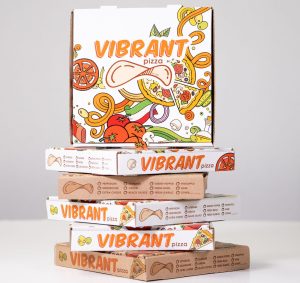
Every product has unique requirements. Corrugated packaging can be customized for size, structure, branding, and protection. Whether it is reinforced boxes for heavy items, inserts for fragile products, or branded packaging that enhances the customer experience, corrugated solutions balance functionality with creativity to meet evolving business needs.
Corrugated packaging has grown beyond traditional shipping boxes. Businesses are now exploring innovative designs, including point-of-sale displays, reusable packaging, and triple-wall bins made from corrugated materials. These designs demonstrate how packaging can be both practical and visually engaging, reflecting creativity while supporting sustainability goals.
Technology is shaping the future of corrugated packaging. Smart packaging, digital printing, and automated production enhance efficiency, accuracy, and customer engagement. These advancements enable businesses to deliver better experiences while optimizing operations, demonstrating that innovation in packaging is not just possible; it is essential.
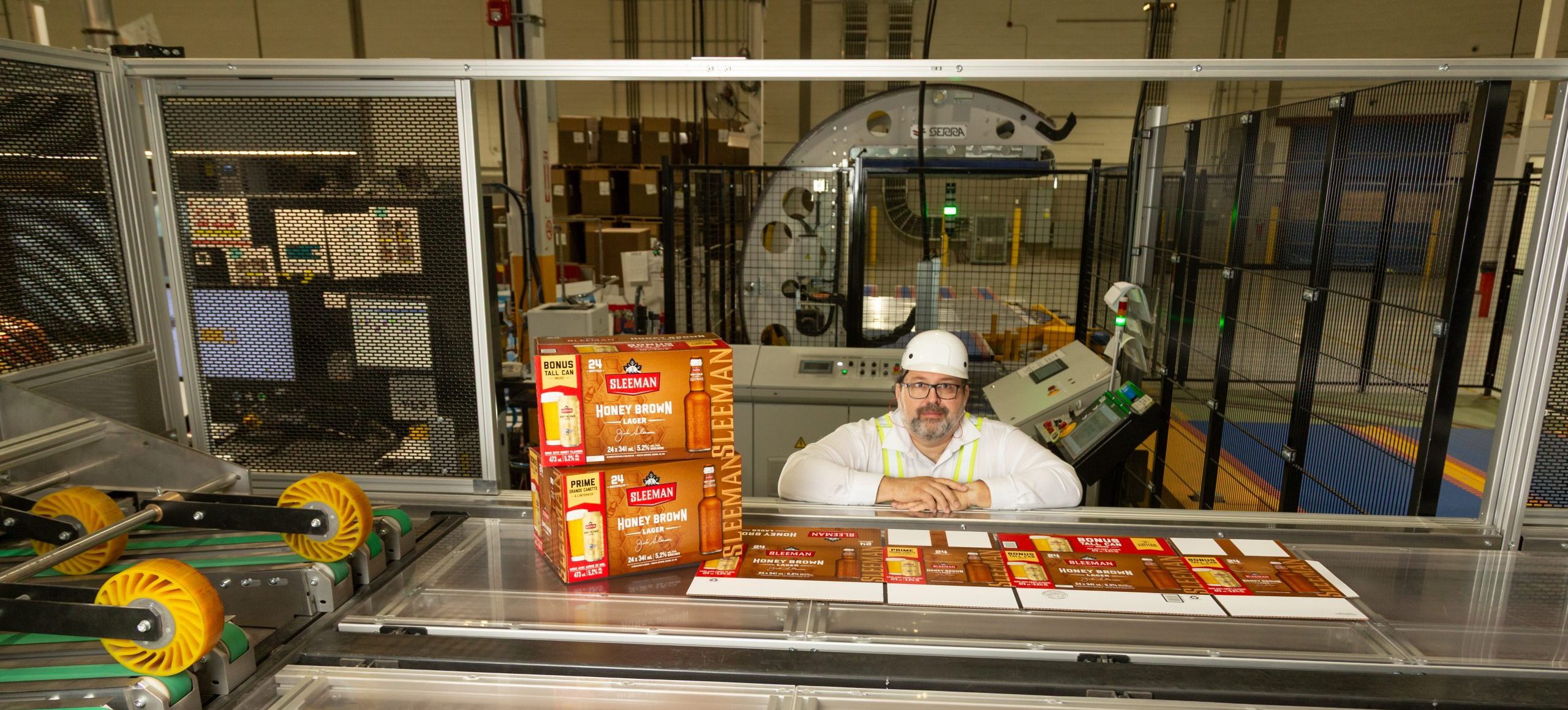
Digitally Printed by Atlantic Packaging Products
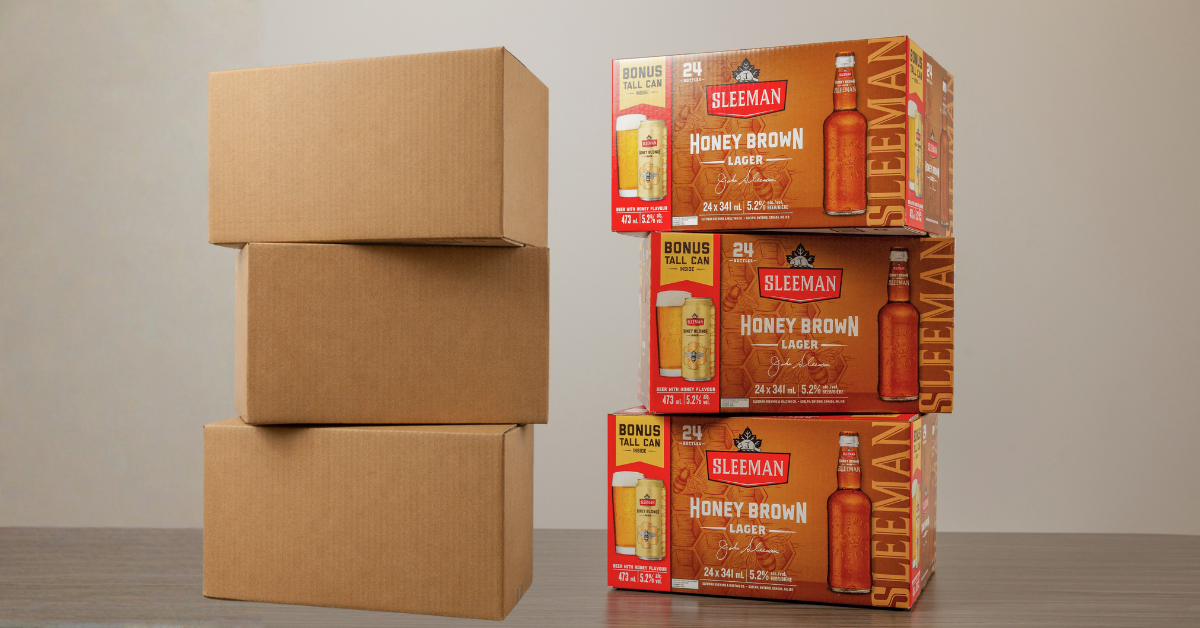
Across Canada, companies are finding creative ways to leverage corrugated packaging to meet marketing and sales requirements for their brands. Read more about a project completed for the third-largest brewer in Canada—Sleeman (pages 8-9). Sleeman needed high-volume, customized corrugated packaging for a smaller, quarterly promotional campaign while maintaining the same brand appearance and quality as their larger production runs.
Atlantic Packaging Products delivered a solution by combining digital printing with preprinted packaging, using the Delta SPC 130 water-based, single-pass press. This approach allowed Sleeman to produce the exact quantities required, maintain consistent quality, and adapt quickly for future promotions. The project demonstrates how Atlantic Packaging’s innovative methods provide flexibility, operational efficiency, and reliable brand consistency, even for complex, smaller-scale campaigns.
Other businesses across industries, from e-commerce to retail, are also leveraging corrugated packaging to enhance product protection, reduce waste, and create unique customer experiences. These real-world applications show how the combination of strength, design, and technology delivers tangible value for customers and partners alike.
Looking ahead, we see exciting trends emerging, including biodegradable coatings, lightweight yet durable designs, and smart packaging solutions integrated with digital tools. As businesses continue to prioritize sustainability, efficiency, and customer experience, corrugated packaging will remain a key enabler of progress and innovation. Corrugated packaging is a versatile, sustainable, and innovative solution shaping the future of industries worldwide. By embracing technology, creativity, and sustainability, businesses can unlock the full potential of their packaging while meeting evolving customer expectations. At the Atlantic Packaging group of companies, we are proud to lead in this space, collaborating with customers, partners, and employees to set new benchmarks for packaging excellence.
© 2026 Atlantic Packaging Products Ltd. All rights reserved.
Atlantic Packaging Products
We firmly believe that the internet should be available and accessible to anyone, and are committed to providing a website that is accessible to the widest possible audience, regardless of circumstance and ability.
To fulfill this, we aim to adhere as strictly as possible to the World Wide Web Consortium’s (W3C) Web Content Accessibility Guidelines 2.1 (WCAG 2.1) at the AA level. These guidelines explain how to make web content accessible to people with a wide array of disabilities. Complying with those guidelines helps us ensure that the website is accessible to all people: blind people, people with motor impairments, visual impairment, cognitive disabilities, and more.
This website utilizes various technologies that are meant to make it as accessible as possible at all times. We utilize an accessibility interface that allows persons with specific disabilities to adjust the website’s UI (user interface) and design it to their personal needs.
Additionally, the website utilizes an AI-based application that runs in the background and optimizes its accessibility level constantly. This application remediates the website’s HTML, adapts Its functionality and behavior for screen-readers used by the blind users, and for keyboard functions used by individuals with motor impairments.
If you’ve found a malfunction or have ideas for improvement, we’ll be happy to hear from you. You can reach out to the website’s operators by using the following email
Our website implements the ARIA attributes (Accessible Rich Internet Applications) technique, alongside various different behavioral changes, to ensure blind users visiting with screen-readers are able to read, comprehend, and enjoy the website’s functions. As soon as a user with a screen-reader enters your site, they immediately receive a prompt to enter the Screen-Reader Profile so they can browse and operate your site effectively. Here’s how our website covers some of the most important screen-reader requirements, alongside console screenshots of code examples:
Screen-reader optimization: we run a background process that learns the website’s components from top to bottom, to ensure ongoing compliance even when updating the website. In this process, we provide screen-readers with meaningful data using the ARIA set of attributes. For example, we provide accurate form labels; descriptions for actionable icons (social media icons, search icons, cart icons, etc.); validation guidance for form inputs; element roles such as buttons, menus, modal dialogues (popups), and others. Additionally, the background process scans all the website’s images and provides an accurate and meaningful image-object-recognition-based description as an ALT (alternate text) tag for images that are not described. It will also extract texts that are embedded within the image, using an OCR (optical character recognition) technology. To turn on screen-reader adjustments at any time, users need only to press the Alt+1 keyboard combination. Screen-reader users also get automatic announcements to turn the Screen-reader mode on as soon as they enter the website.
These adjustments are compatible with all popular screen readers, including JAWS and NVDA.
Keyboard navigation optimization: The background process also adjusts the website’s HTML, and adds various behaviors using JavaScript code to make the website operable by the keyboard. This includes the ability to navigate the website using the Tab and Shift+Tab keys, operate dropdowns with the arrow keys, close them with Esc, trigger buttons and links using the Enter key, navigate between radio and checkbox elements using the arrow keys, and fill them in with the Spacebar or Enter key.Additionally, keyboard users will find quick-navigation and content-skip menus, available at any time by clicking Alt+1, or as the first elements of the site while navigating with the keyboard. The background process also handles triggered popups by moving the keyboard focus towards them as soon as they appear, and not allow the focus drift outside it.
Users can also use shortcuts such as “M” (menus), “H” (headings), “F” (forms), “B” (buttons), and “G” (graphics) to jump to specific elements.
We aim to support the widest array of browsers and assistive technologies as possible, so our users can choose the best fitting tools for them, with as few limitations as possible. Therefore, we have worked very hard to be able to support all major systems that comprise over 95% of the user market share including Google Chrome, Mozilla Firefox, Apple Safari, Opera and Microsoft Edge, JAWS and NVDA (screen readers).
Despite our very best efforts to allow anybody to adjust the website to their needs. There may still be pages or sections that are not fully accessible, are in the process of becoming accessible, or are lacking an adequate technological solution to make them accessible. Still, we are continually improving our accessibility, adding, updating and improving its options and features, and developing and adopting new technologies. All this is meant to reach the optimal level of accessibility, following technological advancements. For any assistance, please reach out to
We use cookies to enhance your browsing and personalize content. By continuing to use this website, you agree to our use of cookies as outlined in our Privacy Policy.